
Snowmobiles: Safety tips
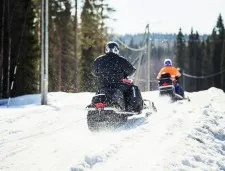
Snowmobiling is a popular winter activity in Canada. But each year, many people are seriously injured while snowmobiling. Head injuries are the leading cause of serious injury or death on snowmobiles.
Injury can happen when:
- the snowmobile hits a tree, another snowmobile or other motorized vehicle,
- a child/teen falls from the snowmobile, or the snowmobile rolls over them,
- the snowmobile breaks through the ice or comes across open water,
- loading or unloading a snowmobile,
- riding conditions are unsafe (such as bad weather).
Children and teens under 16 years of age should not operate snowmobiles.
- To safely drive a snowmobile, you need to be strong, skilled, and mature.
Children under the age of 6 should never ride as passengers on a snowmobile.
- Head injuries are more common in passengers than in drivers. It takes strength and stamina to be a passenger on a snowmobile. Passengers need to hold on tight for a long period of time, which can be hard to do, especially when the snowmobile is running over bumpy ground at a high speed.
How can snowmobiles be used safely?
If you’re a parent who operates a snowmobile, you can model safe behaviour by following these guidelines:
Before you go out
- Check the weather forecast.
- Check the condition of the trails. In some areas, you may need to see if there is danger of an avalanche. Do not snowmobile on ice if you’re not sure how thick it is or what condition it’s in.
- Be careful when fueling your snowmobile to avoid burns and explosions.
- Take care when loading snowmobiles on and off trailers to prevent strains and crush injuries.
- Learn the signs of hypothermia (when body temperature drops to dangerously low levels) and frostbite and what to do if this happens.
Have the right equipment
- Wear well-insulated protective clothing, including goggles, waterproof snowmobile suits and gloves, and rubber-bottomed boots.
- Drivers and passengers should wear helmets that meet Canadian standards.
- Snowmobiles should have brightly coloured antenna flags mounted on rods that are 1.2 m to 2.4 m long, located on the back of the machine. This is especially important if you’re driving in a hilly area, so that others can see you.
- Carry a first-aid kit, an emergency tool kit (with spark plugs, and drive and fan belts), an extra key, and a survival kit that includes flares.
- Carry a phone if you’re in an area with service or get a satellite phone for greater coverage.
Drive safely
- No one younger than 16 years old should drive a snowmobile.
- Never allow children younger than 6 years old to ride as passengers.
- Do not carry more than one passenger.
- Don’t pull people on saucers, tubes, tires, sleds or skis behind a snowmobile. If you must tow someone, the safest way is to use a sled or cutter attached to the snowmobile by a rigid bar connection.
- Travel at a slow speed over level terrain, away from trees, rocks and other vehicles. A spotter should always watch when someone is being towed.
- Beginners should stick to groomed trails and drive during the day.
- Always travel at safe speeds. Many trails have posted speed limits.
- Be extra careful on unfamiliar or rugged terrain where you might run into hazards you can’t see, such as barbed wire.
- Cross roads carefully where permitted. Collisions between snowmobiles and other motor vehicles most commonly happen at intersections between trails and roads.
- Always keep headlights and tail lights on so that you can see, and so that others can see you.
- Travel in groups of 2 or more, and only on marked trails away from roads, waterways, railroads and pedestrian traffic.
- Never drink alcohol or use prescription or non-prescription drugs (including marijuana) that make you drowsy or alter your judgment before or while operating a snowmobile.
Are there laws in Canada about operating snowmobiles?
- Every province and territory has its own rules about the use of snowmobiles. It’s best to check with your provincial/territorial transportation authority for specifics.
Additional resources
Reviewed by the following CPS committees
- Injury Prevention Committee
Last updated: January 2023