Healthy bowel habits for children
Regular bowel movements are important to your child’s health. Bowel habits—how often, how much, and so on—will vary from child to child. Some children go more than once a day, while others may skip a day.
You can encourage healthy bowel habits by:
- Eating healthy foods — whole grains, fruits and vegetables — and drinking more water each day. Children should have no more than 120 ml of 100% fruit juice per day. Less is better!
- Staying active throughout the day. This will help keep bowels working well.
- Teaching your child not to hold a bowel movement.
- Explaining that regular bowel movements are normal and important for good health.
- Not using negative words like “dirty” or “stinky,” because they can make your child feel self-conscious about going to the toilet.
The most common problems with bowel movements are constipation and diarrhea.
What are symptoms of constipation?
Constipation can happen when bowel movements:
- are passed less often than usual, and/or,
- are hard and dry, and difficult or painful to pass, and/or
- seem unusually large for your child.
Constipation can cause stomach pain and bright red blood on the surface of a hard stool.
If your child is constipated, it may seem like they are straining to go to the bathroom. In fact, they are holding it in because it hurts to go.
What causes constipation?
- A low-fibre diet that doesn’t include enough whole grains, fruits and vegetables.
- Products with more than 4 grams of fibre per serving (listed on the package) are good sources of fibre.
- Too much milk, juice, or other dairy products can cause your child to feel full. That means they will eat less of other foods that help their bowels work well.
- Being afraid to use the toilet. Your child may also hold back a bowel movement if there is a crack or tear around the anus, causing pain.
- Not enough physical activity.
- Some mediciations.
What can I do if my child is constipated?
- Try to get your child used to a regular daily toilet routine.
- Do not rush toilet learning. Children can worry and hold back bowel movements if they feel pressured.
- Offer foods that are high in fibre such as whole grain breads, fruits like apples, ripe bananas, berries or prunes, vegetables and legumes (split peas, soy and lentils).
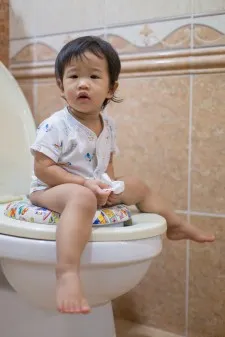
- Give your child a firm support for their feet (such as a small footstool), and a toilet reducer ring, when they are passing a bowel movement. It will make it easier to push.
What are symptoms of diarrhea?
- More bowel movements, with stool that is less formed and more watery than usual.
What causes acute diarrhea?
There are many causes of diarrhea, though it’s usually caused by a virus. The most common cause of acute infectious diarrhea in Canada is a virus called rotavirus. Acute diarrhea usually lasts less than 14 days.
The germs that cause diarrhea, including rotavirus:
- spread easily from person to person, and especially from child to child.
- usually spread easily among children who have not learned to use the toilet.
You can prevent severe diarrhea caused by rotavirus by having your infant vaccinated. You can also reduce the spread of the virus by washing your hands and your child’s hands carefully after every diaper change, after going to the toilet, and before preparing and eating food.
What can I do if my child has diarrhea?
Children with diarrhea can lose fluids quickly. It’s important to keep offering food and drink to your child. An oral rehydration solution (ORS), an exact mixture of water, salts and sugar, can be used to help keep your child well hydrated when diarrhea is serious.
What are some causes of chronic diarrhea?
Chronic diarrhea is diarrhea that last for more than 14 days. One fairly common cause of chronic diarrhea in children is often called toddler’s diarrhea.
What is toddler’s diarrhea?
Toddler’s diarrhea usually starts between the ages of 6 and 30 months and will go away by the time your child is about 5 years old. Children with toddler’s diarrhea may have 2 to 6 watery stools each day, but otherwise seem well and gain weight normally.
The exact cause of toddler’s diarrhea isn’t known, but it may be because some food moves more quickly through your child’s colon (the last part of the body’s digestive system).
- Your toddler may drink too many sweetened drinks, such as juice or sports drinks, which can cause loose stool.
- It may also be caused by a lack of fibre in your child’s diet or by eating foods that are too low in fat.
If your toddler has loose, watery stools often:
- Stop offering juice and give water instead. Juice has sugar that can make the diarrhea worse.
- Offer more food with fibre, such as whole grain cereals, fruits and vegetables.
If the diarrhea continues, talk to your doctor at your next regular visit.
When should I call my doctor?
Call your doctor if your child:
- has diarrhea and is younger than 6 months of age.
- is often constipated.
- has bloody or black stool.
- is toilet trained, but starts to lose some control of their bowel and has accidents in their underwear.
- has diarrhea and a fever with a temperature higher than 38.5°C (101.5°F).
- has signs of dehydration (increased thirst, no tears, peeing less, dry skin, mouth and tongue, faster heartbeat).
- is not gaining weight.
Reviewed by the following CPS committees
- Nutrition and Gastroenterology Committee
- Public Education Advisory Committee
Last updated: July 2018